Sunday, October 23, 2011

Recipe of the week: Easy (and filling) vegetarian chili

Now that it's getting cold, hot soups and stews are comforting and delicious. Here's a recipe for easy vegetarian chili that's filling and good for you. You can use the vegetables suggested, or add anything else that is in your fridge, like carrots, corn or celery. Cornbread on the side makes a perfect fall meal.

Vegetarian Chili

Ingredients
2 medium zucchini, chopped
1 medium onion, chopped
1 green pepper, chopped
1 red pepper, chopped
3 cloves garlic, minced
3 tablespoons olive oil
2 28-ounce cans Italian stewed tomatoes, cut up
1 15-ounce can tomato sauce
1 15-ounce can pinto beans
1 jalapeno pepper, seeded and chopped
1/4 cup fresh cilantro, minced
1/4 cup fresh parsley, minced
3 tablespoons chili powder
1 tablespoon sugar
1 teaspoon salt
1 teaspoon cumin

Directions
1. In a large pot, saute zucchini, onion, peppers and garlic in oil until tender.
2. Stir in all remaining ingredients.
3. Bring to a boil.
4. Reduce heat, cover and simmer for 30 minutes, stirring occasionally.

Recipe credit: Food.com
Photo credit: Bhakti in NYC

Monday, October 17, 2011

How to can tomatoes (it's easier than you think)

So, I used to be afraid of canning because I thought it was way too complicated and required expensive materials. But after our generous neighbors gave us a water bath canner (see one here - it only costs about $20, and it's really just a giant pot), we finally gave it a try. It turned out to be pretty easy, and a lot of fun! It made me feel like an accomplished adult, as if canning was some right of passage to adulthood. But besides that, canning is a great way to preserve food in order to have fresh, flavorful vegetables all year long.

An easy place to start is by canning whole tomatoes. They don't require a lot of preparation, and you can use whole tomatoes in all sorts of recipes. We love to use them for making pizza sauce; just dump the tomatoes, juice and all, into the pan and mash them up to make flavorful sauce.

Here's our method for canning whole tomatoes. We learned by using this website and this book, two great resources for canning all kinds of things.

Step 1: Buy a ton of tomatoes, or use the ones you've grown.

If you're lucky enough to have a garden, this is a great way to use up tomatoes that are becoming too ripe. If you don't have a garden, go to the farmers market in late September. Farmers often sell bulk tomatoes for really cheap, because they're trying to get rid of them. It doesn't really matter how many tomatoes you get. It just depends on how many you want canned. We bought 20 pounds of tomatoes, and it made about 15 pint-size jars of tomatoes.

bulk tomatoes bought at the farmers market

Step 2: Sanitize your jars.

You can just put your jars in the dishwasher on the "sanitize" cycle. If you don't have a dishwasher, put the jars in boiling water. Don't put the lids in the dishwasher. Instead, dip those in boiling water before you are ready to use them. Meanwhile, fill your water bath canner halfway with water, and start bringing it to a boil. 

Step 3: Peel the tomatoes.

The quickest way to do this is to blanch the tomatoes. Get a big pot of water boiling, and drop the tomatoes a few at a time into the boiling water. Once the skins start to break, take the tomatoes out with a slotted spoon and place them in a bowl of ice water. This will stop them from cooking further. Use your hands to slide the skin off the tomato.

the tomatoes after blanching and peeling them
Step 4: Cut the cores out of the tomatoes.

You can actually do this step before peeling the tomatoes, or afterwards. Whatever you think will be easiest. Cut out the cores (which is just the top part, near where the stem was attached) and any bruises or bad spots. You'll probably end up with some squished tomatoes, but we use those anyway.

Step 5: Put the tomatoes in the jars.

We use a slotted spoon that we have dipped in boiling water to put the tomatoes in. You can also use a funnel (which should be sanitized ahead of time). After you fill the jars, take a spoon handle and slide it around the inside edge of the jar. This will get rid of any air bubbles.

Step 6: Add lemon juice and water (if needed).

Add two tablespoons of lemon juice to all the jars. If there is still too much room at the top, add some boiling water. There should only be a half inch of space between the liquid and the top of the jar (this is called "head space").  Put the lids on the jars.

Step 7: Put the jars in the boiling water, and boil for 35 minutes.

Your water bath canner probably came with a rack that you can put the jars on so they don't touch the bottom of the pot. (This can cause the jars to break.) We use one of these fancy jar holders to slide the jars into the boiling water. (And by "fancy," I mean they cost $5 at the hardware store.)

the filled jars in the water bath canner
That's it! Take the jars out, and wait for them to cool. After a few hours, check to make sure the lids have sealed. You'll know because the lid won't pop back up after you push down on it. And voila, you've canned tomatoes!

Saturday, October 8, 2011

Hunger in America, represented on Sesame Street

A friend of mine sent me a link to a story that surprised me. Apparently Sesame Street will be debuting a new Muppet character, named Lily, who is food-insecure (which is the government's word for "hungry"). This makes me simultaneously sad and happy. Sad because the number of hungry children in the country is so great that it necessitates a TV character to represent it. Happy because children who are not hungry will learn about those that are, in a gentle and powerful way.

Hunger is a huge and basic issue for so many families in America. 49 million Americans live in food-insecure houses, which includes 16 million children. And evidently, food pantries are struggling to feed people, both because the number of hungry people is increasing, and because their budgets are being cut. Hunger is a problem in big cities, and it's also a problem in the suburbs.

But primarily, hunger is a problem of poverty. Forty percent of families below the poverty line are food insecure. Children who are hungry are more likely to do poorly in school, have developmental problems, and suffer from illness and depression, conditions which presumably increase the likelihood that they will stay poor. With one in six people hungry in the U.S., this might just be the biggest problem that many (including myself) haven't been paying attention to.

To learn how many people are suffering from hunger in your state, click on this map and hover over your state. And click here for ideas on how to help.


Saturday, October 1, 2011

Eating unhealthy not necessarily cheaper

There's a myth going around that eating healthy is expensive. People use it as an explanation for why obesity is such a huge problem in this country. This idea, wherever it came from, is a pretty dangerous one. I've worked with both children and parents who think eating healthy is not worth it because it's beyond their financial means. As a result, they don't make the effort to pick out meals that are good for them.

While I agree that organic produce is pricey and your average person can't afford to shop at Whole Foods, that narrow subset of food choices is not the only type of food that fits the definition of "healthy." Healthy foods are simple, unprocessed foods, can be found at any supermarket, and provide a multitude of nutrients that keep you full longer. And, as Mark Bittman explains using the graphic below, healthy foods are often cheaper. By a lot.


Once you realize that choosing healthy foods won't wreak havoc on your budget, the next step is to learn to cook them.

Thursday, September 22, 2011

Fifty people answer: What's your favorite memory?

There are a lot of sad things going on in our country right now. Just this morning, in ten minutes of reading the news, I came across awful stories of bullying and teen suicides, tragic executions, simultaneous hunger and obesity. But then I came across this video, which made me feel better about life. Sometimes, learning to live a healthy life means (temporarily) forgetting all that's wrong in the world...and remembering that there are so many beautiful, happy, wonderful people out there. For a little cheering up, watch this sweet video of people sharing their favorite memory. Then try to recall your own.


Via feministing.com

Wednesday, September 14, 2011

The food we waste

Lately I've been helping Seven Generations Ahead create a food curriculum called "Linking Plants and Food," which teaches middle school students important issues about food and food politics. The kids will learn that almost everything we eat comes from a plant, and how to design a school garden. They also learn about food waste, and how to reduce it through composting. While doing research for this lesson on food waste, I came across some shocking statistics.

Every year Americans throw away 34 million tons of food. 34 million tons! In one month, a family of four throws away 122 pounds of food, or a pound per person per day. We throw away up to 30% of the food available to us each year.

There are so many reasons why this is terrible. It's terrible because the food in our landfills produces high amounts of methane, which is a powerful greenhouse gas that contributes to global climate change. It's terrible because it's a huge waste of money (up to $31 billion a year). It's terrible because throwing away this food is disrespectful to the farmers who worked to produce it.

But most of all, it's terrible because we live in a world where so many people are hungry, while others throw away food because it looks slightly bruised or was forgotten in the back of the refrigerator. Our food waste habits are taking away food from these hungry people. We buy too much food, and it drives up grain prices, making food unaffordable for people in poverty.

But that means that if Americans (and Brits) stopped wasting so much food, we could help alleviate hunger. In fact, we could almost eliminate it completely. At least one billion people could be lifted out of hunger with only a quarter of the food we waste. One billion!

We need to start reducing our food waste. The EPA has its own plan for how to do it nationally. Here, and here, and here are some tips on how to do it in your own kitchen.

And, for some visual fun, here is an infographic on how much food we waste. Click on the picture for a larger image.


Friday, September 9, 2011

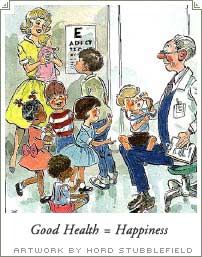
Why I won't be seeing a doctor this year

Most of my blog posts in the past have focused on individual choices you can make to live a healthy life: eat more vegetables, exercise more, learn to cook from scratch. While these are important steps to take, they don't constitute the whole picture of healthy living. There's a whole host of forces in society that make it more difficult to be healthy. And one of the biggest problems, one that I often overlook until it slaps me in the face, is lack of access to quality health care.

Disclaimer: This post is long. If you don't have time to read it all, the general message is this: Not having health care is a major problem for many people of different income levels. Please consider donating to clinics that serve uninsured individuals, and support policies that will improve access to affordable health care.

As you may have guessed, I support universal health care for multiple reasons. I think it's a fundamental right that Americans deserve. I think it's the job of our government to care for those most in need. But the biggest reason I support universal health care? Because without it, I can't even get a basic doctor's appointment.

Now theoretically, getting a doctor's appointment should be easy for me. I come from a middle-class family and have a college degree. I speak English as a first language, and I'm not afraid to speak assertively to persons of authority. All these things are to my advantage, and yet scheduling a doctor's appointment has always been my idea of a living hell.

Know why? Because I don't have health insurance.

I have held wonderful teaching jobs for the past three years, but only one was full-time, and I haven't had health benefits for a year or more. Unfortunately, health insurance is not offered by all employers. People who work part-time or for a non-profit or are self-employed are usually uninsured, unless they want to pay through the teeth for private individual insurance. States offer insurance for low-income individuals, but these are not often affordable. In New York, I would have paid $350/month for basic health insurance, while working two part-time jobs.

Therefore, I am stuck with no health insurance. And that means I will probably never see a doctor unless I absolutely have to. Unfortunately, at this point in my life, preventative care is just not worth it to me, considering the hassle, humiliation, and financial challenges I have to face to see a doctor.

Here's a recent example. My newest employer, a nature center run by the city, asked me to get a health physical before beginning the job. A simple request, for most people who are insured. But for those who aren't, it's much more complicated...
Step #1: Find a health clinic who will take me. 
While the wonders of the internet should make this simple, I have a few limitations. I can't go to a regular private clinic, because the costs for uninsured patients are outrageous. Even if I did want to shell out the money, I don't have an assigned doctor there, so I would have to wait a month to have a "New Patient Appointment," then wait another few weeks to see a doctor. This would mean I couldn't start my new job for at least two months. 
I also can't go to some of the free clinics, because they don't offer routine preventative care like health physicals. They're also only open limited hours, mostly during the weekday, leaving me no options if I am already working full-time. (I'm not, but others often face this problem.) 
Step #2: Make the appointment. 
This involves waiting on hold for at least twenty minutes, if not longer, since low-income health care clinics are often understaffed. I finally got through to the county health clinic, and they told me the earliest I could see a doctor was in November, and that was for a New Patient Appointment. (See Step #1.) Wonderful. 
Crossing that clinic off the list, I moved on to the Cristo Rey clinic, whose website said they serve uninsured community members at the low cost of $20 per visit. Perfect. Keep in mind that this nature center job that requires the physical, while a wonderful opportunity, is only paying me $9/hr, so I can't afford an expensive doctor visit. 
I decided to call this place. After my second attempt at connecting with someone, the receptionist was very confused and rude when learning that I needed a physical for employment. "Don't you have a family doctor?" she snapped. No, I replied patiently, as I already told you, I don't have health insurance, and haven't had a "family doctor" since I was 17. After we got through these introductions, the clinic then informed me that they don't do physicals for new patients, and if they did, it would cost $80. I would have to work more than a full day to pay that off. 
So far I have spent at least 45 minutes on the phone in this process, and still no successful appointment. I also tried Planned Parenthood, whose website said they do employment physicals, but apparently this was erroneous. The receptionist there was shocked when I asked to schedule a physical, and derisively told me "we don't do that here."
Now, this particular story actually has a happy ending. Someone suggested that I look for an urgent care facility, and I was lucky enough to find one which actually took walk-ins and only charged me $39. Awesome for me, but not typical. In my experience in both Chicago and New York, the costs were much higher. I have paid $350 out of pocket for a gynecological appointment, and have heard stories that are much worse. But at least I found a place, so that meant I could move on to the next step.
Step #3: Get to the clinic. 
For most people this requires taking time off work, which often equates with a smaller paycheck. I also needed to consider what neighborhood the clinic was in. When I lived in Chicago, there were several neighborhoods where I didn't feel comfortable walking alone. And taking a buddy along was not really an option. Who's going to come to a doctor's appointment with me in the middle of the workday? 
I'm also lucky enough to have a car, but many people need to navigate bus routes, resulting in even more time off work. 
Step #4: Actually get seen by a doctor. 
Now, this is my least favorite step. I have gone to my share of county clinics, and some are better than others. But most are loud, busy, smelly, and stressful. The receptionists are shouting, babies are crying, moms are yelling. The wait is usually at least an hour, if not more (which is annoying at best and takes away from precious work time at worst). The medical staff are trying their hardest, but they're underpaid and understaffed, and stressed. As a result, "welcoming" is not a word I would often use to describe these clinics.
The rest of the appointment is probably pretty typical whether you have insurance or not: the nurse gets me and takes my vitals, then I wait another twenty minutes to see the doctor, then the doctor breezes in and out since I'm her nineteenth patient that day. 
 But finally, after giving up time, money, patience, and dignity, I have seen a doctor.
Now, this small experience, which I have repeated every time I need to see a doctor, is the reason why I support universal health care. It's the reason why the employer-based health care system is not working. The system is not providing people with health care that will prevent them from getting sick.

But until this system gets fixed, please consider donating to a low-income health care clinic in your area. There are people who are facing much larger health issues than I am, and they have a right to see a doctor.

Image source: Carolina Living Health Care
Related Posts Plugin for WordPress, Blogger...