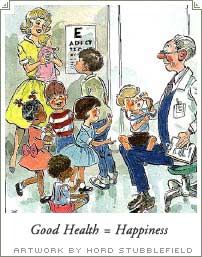
Showing posts with label health care. Show all posts

Sunday, August 5, 2012

Inspiration for the weekend: Quiche, mental health, and amazing Olympians

one of the images posted on I.A.M.
I'm staying with my family this weekend, and my mom is making a quiche for dinner. I haven't had a quiche since I lived with one of my college roommates, who would make a version of this delicious potato-crust quiche!

This badass college student fought his insurance company, via Twitter, to pay for his cancer treatments, and he won.

I came across this project called Internal Acceptance Movement (I.A.M.), put together by a 20-year-old who struggled (and still struggles) with an eating disorder. She posts inspirational quotes, images, and stories for people who are struggling with their body image, depression, or other mental unhappiness.

The U.S. Women's Gymnastic Team member McKayla Maroney causes a judge's jaw to drop. You go girl.

Monday, July 30, 2012

Whose responsibility is it to pay our exorbitant medical bills?

I don't know enough about the Affordable Care Act to swear by it. I'm not sure if it is without a doubt the best possible plan that anyone could have come up with. I'm sure there are lots of flaws (although they weren't put there purposely by President Obama). Despite its imperfections, though, I believe that it's better than nothing. We had to do something. From my own personal experience, the health insurance world is a nightmare to navigate. I have had multiple bills in the hundreds of dollars that weren't covered for some obscure reason, or because my employer didn't offer health insurance and therefore I was paying out of pocket. And my bills were just for routine medical or dental checkups. I have been very fortunate not to have any debilitating illnesses or major accidents. If I had, I know that I would be in enormous debt right now, either to credit card companies or to my family. Neither of which is a desirable option.

But it's accounts like this one that really get me upset about the health care system. In this moving article, a college professor ends up tens of thousands of dollars in debt because her partner comes down with advanced-stage Lyme disease. Her health insurance hasn't kicked in yet, so they have to pay out of pocket for several weeks, and no one is able to diagnose her properly. The partner is in extreme pain and misery, and all she can do is watch helplessly. Eventually, thousands of dollars later, they get an accurate diagnosis, and it turns out to be a diagnosis that isn't covered by health insurance! They end up having to start a website to plead for help from their friends and family. Fortunately, they raise a lot of money, and are able to pay their bills.

But it's just ridiculous that people need to go to such lengths as designing a website to beg for help to pay simple medical bills. Imagine if they had been a family with less know-how, who didn't have such a network of support that helped them navigate web design and mounting bills. Imagine being an English language learner, who is trying to understand stacks of paperwork that involve "deductibles," "claims," and other confusing requirements. Imagine being a single mother who can't pay her child's medical bills because her employer either can't or won't insure her. There are endless scenarios where people's lives are ruined, temporarily or permanently, because of our unsupportive, confusing health care system.

While I don't think the Affordable Health Care Act is perfect, I do think it's a good start. We had to start somewhere, so stories like this don't go on. As this article said, "It is not our community's responsibility to pay our exorbitant medical bills, to prevent our lives from being annihilated by the cost of illness. It is our government's responsibility."

Image source: NYTimes

Thursday, December 1, 2011

A culture of health in America

Amsterdam, where travel by bike is easy
I've been thinking a lot lately about what it means to be American. Now, I don't want to get too deep into it. I don't want to talk about patriotism and freedom and democracy and all that. Basically, I'm considering how being an American relates to living a healthy life. This particular train of thought was inspired by several insightful blog posts I've read lately, as well as discussions with family and friends over the Thanksgiving holiday. We have two close friends from Spain who have lived here for the past year. In a recent conversation we asked them to tell us some stereotypes of America that they'd heard before they moved here. I should note that, after answering, they pointed out that stereotypes are often inaccurate (as an example, they informed us that everyone in Spain doesn't fight bulls and wear red).

After "don't know anything about other countries," they said another stereotype is that Americans are fat and eat unhealthy diets. How sad, I thought! Besides ignorance, we are known around the world as being the unhealthy country. Indeed, the obesity rate is pushing 33% of all Americans. One in three people are overweight or dangerously overweight. Indeed, we subsidize the growing of corn and soy instead of healthier fruits and vegetables. And indeed, we eat a lot of fast food.

But, I said to myself, I eat healthy. My friends and family eat healthy. I don't have any close friends that are particularly overweight. But I realize that this fact is largely based on where I live and my income level. Where you live and how much money you have really makes a difference in your health in this country. For example, in this insightful article from Feministing's community blog, the author describes where she lives:
As for me, I live in Washington, DC, where wealth and means converge. Exercise is trendy, as is eating healthily. Grocery stores, co-ops, and farmer’s market, all devoted to providing high quality food products are everywhere. An affluent population is willing and able to pay more for the privilege.
Although I don't live in DC, the same set of circumstances was true in Chicago, Madison, and various other places I've lived. It was easy for me eat healthy. I was lucky enough to be taught how to cook by my family and friends. The importance of exercise has been instilled in me, and I could walk or take the bus almost everywhere. Additionally, the city was full of people who ran, biked, and played sports. You couldn't drive through the north side of Chicago without seeing dozens of runners and several yoga studios. But that's not the case in other places. As the author goes on to say,
Are these same options present in Alabama, especially in the rural areas or the inner city? Not so much. Does a tradition and corresponding cultural expectation of these sorts of beneficial practices exist? Not really. Cities are concentrations of wealth and the highly educated. There is no financial incentive for either of them to leave and spread elsewhere. Quality food is rarely found in areas of poverty. Most often, only cheaper, lower quality food is affordable and available.
In addition to quality food, there are other aspects of health that are only accessible to the wealthy: health insurance, gym memberships, time to cook meals from scratch, reduced exposure to fast food ads, the privilege of living in a safe neighborhood.

I don't have a solution for this issue that our country faces, in which where you live and how much money you have has a disproportionate effect on your health. I wish that healthy food was cheaper and available everywhere. I wish there were bike lanes and bus routes in all areas, including surburban and rural towns. I wish we were taught in school how to cook, maintain a healthy diet, and build exercise into our schedules. I wish minimum wage was higher, so people could work less and spend more time cooking. I wish kids were given more time for recess and had greener cities.

I wish that health was an expectation our country, just part of our general culture, instead of a privilege. I don't think that individuals can be blamed for their obesity or heart disease or poor eating habits, at least not entirely. Right now, living in our country makes it harder to be a healthy person, instead of easier. I hope someday that will change. I hope, however naively, that someday when people think of Americans, they will think of healthy people.

Photo credit

Friday, September 9, 2011

Why I won't be seeing a doctor this year

Most of my blog posts in the past have focused on individual choices you can make to live a healthy life: eat more vegetables, exercise more, learn to cook from scratch. While these are important steps to take, they don't constitute the whole picture of healthy living. There's a whole host of forces in society that make it more difficult to be healthy. And one of the biggest problems, one that I often overlook until it slaps me in the face, is lack of access to quality health care.

Disclaimer: This post is long. If you don't have time to read it all, the general message is this: Not having health care is a major problem for many people of different income levels. Please consider donating to clinics that serve uninsured individuals, and support policies that will improve access to affordable health care.

As you may have guessed, I support universal health care for multiple reasons. I think it's a fundamental right that Americans deserve. I think it's the job of our government to care for those most in need. But the biggest reason I support universal health care? Because without it, I can't even get a basic doctor's appointment.

Now theoretically, getting a doctor's appointment should be easy for me. I come from a middle-class family and have a college degree. I speak English as a first language, and I'm not afraid to speak assertively to persons of authority. All these things are to my advantage, and yet scheduling a doctor's appointment has always been my idea of a living hell.

Know why? Because I don't have health insurance.

I have held wonderful teaching jobs for the past three years, but only one was full-time, and I haven't had health benefits for a year or more. Unfortunately, health insurance is not offered by all employers. People who work part-time or for a non-profit or are self-employed are usually uninsured, unless they want to pay through the teeth for private individual insurance. States offer insurance for low-income individuals, but these are not often affordable. In New York, I would have paid $350/month for basic health insurance, while working two part-time jobs.

Therefore, I am stuck with no health insurance. And that means I will probably never see a doctor unless I absolutely have to. Unfortunately, at this point in my life, preventative care is just not worth it to me, considering the hassle, humiliation, and financial challenges I have to face to see a doctor.

Here's a recent example. My newest employer, a nature center run by the city, asked me to get a health physical before beginning the job. A simple request, for most people who are insured. But for those who aren't, it's much more complicated...
Step #1: Find a health clinic who will take me. 
While the wonders of the internet should make this simple, I have a few limitations. I can't go to a regular private clinic, because the costs for uninsured patients are outrageous. Even if I did want to shell out the money, I don't have an assigned doctor there, so I would have to wait a month to have a "New Patient Appointment," then wait another few weeks to see a doctor. This would mean I couldn't start my new job for at least two months. 
I also can't go to some of the free clinics, because they don't offer routine preventative care like health physicals. They're also only open limited hours, mostly during the weekday, leaving me no options if I am already working full-time. (I'm not, but others often face this problem.) 
Step #2: Make the appointment. 
This involves waiting on hold for at least twenty minutes, if not longer, since low-income health care clinics are often understaffed. I finally got through to the county health clinic, and they told me the earliest I could see a doctor was in November, and that was for a New Patient Appointment. (See Step #1.) Wonderful. 
Crossing that clinic off the list, I moved on to the Cristo Rey clinic, whose website said they serve uninsured community members at the low cost of $20 per visit. Perfect. Keep in mind that this nature center job that requires the physical, while a wonderful opportunity, is only paying me $9/hr, so I can't afford an expensive doctor visit. 
I decided to call this place. After my second attempt at connecting with someone, the receptionist was very confused and rude when learning that I needed a physical for employment. "Don't you have a family doctor?" she snapped. No, I replied patiently, as I already told you, I don't have health insurance, and haven't had a "family doctor" since I was 17. After we got through these introductions, the clinic then informed me that they don't do physicals for new patients, and if they did, it would cost $80. I would have to work more than a full day to pay that off. 
So far I have spent at least 45 minutes on the phone in this process, and still no successful appointment. I also tried Planned Parenthood, whose website said they do employment physicals, but apparently this was erroneous. The receptionist there was shocked when I asked to schedule a physical, and derisively told me "we don't do that here."
Now, this particular story actually has a happy ending. Someone suggested that I look for an urgent care facility, and I was lucky enough to find one which actually took walk-ins and only charged me $39. Awesome for me, but not typical. In my experience in both Chicago and New York, the costs were much higher. I have paid $350 out of pocket for a gynecological appointment, and have heard stories that are much worse. But at least I found a place, so that meant I could move on to the next step.
Step #3: Get to the clinic. 
For most people this requires taking time off work, which often equates with a smaller paycheck. I also needed to consider what neighborhood the clinic was in. When I lived in Chicago, there were several neighborhoods where I didn't feel comfortable walking alone. And taking a buddy along was not really an option. Who's going to come to a doctor's appointment with me in the middle of the workday? 
I'm also lucky enough to have a car, but many people need to navigate bus routes, resulting in even more time off work. 
Step #4: Actually get seen by a doctor. 
Now, this is my least favorite step. I have gone to my share of county clinics, and some are better than others. But most are loud, busy, smelly, and stressful. The receptionists are shouting, babies are crying, moms are yelling. The wait is usually at least an hour, if not more (which is annoying at best and takes away from precious work time at worst). The medical staff are trying their hardest, but they're underpaid and understaffed, and stressed. As a result, "welcoming" is not a word I would often use to describe these clinics.
The rest of the appointment is probably pretty typical whether you have insurance or not: the nurse gets me and takes my vitals, then I wait another twenty minutes to see the doctor, then the doctor breezes in and out since I'm her nineteenth patient that day. 
 But finally, after giving up time, money, patience, and dignity, I have seen a doctor.
Now, this small experience, which I have repeated every time I need to see a doctor, is the reason why I support universal health care. It's the reason why the employer-based health care system is not working. The system is not providing people with health care that will prevent them from getting sick.

But until this system gets fixed, please consider donating to a low-income health care clinic in your area. There are people who are facing much larger health issues than I am, and they have a right to see a doctor.

Image source: Carolina Living Health Care
Related Posts Plugin for WordPress, Blogger...