Via feministing.com
Thursday, September 22, 2011
Fifty people answer: What's your favorite memory?
There are a lot of sad things going on in our country right now. Just this morning, in ten minutes of reading the news, I came across awful stories of bullying and teen suicides, tragic executions, simultaneous hunger and obesity. But then I came across this video, which made me feel better about life. Sometimes, learning to live a healthy life means (temporarily) forgetting all that's wrong in the world...and remembering that there are so many beautiful, happy, wonderful people out there. For a little cheering up, watch this sweet video of people sharing their favorite memory. Then try to recall your own.
Via feministing.com
Via feministing.com

Wednesday, September 14, 2011
The food we waste
Lately I've been helping Seven Generations Ahead create a food curriculum called "Linking Plants and Food," which teaches middle school students important issues about food and food politics. The kids will learn that almost everything we eat comes from a plant, and how to design a school garden. They also learn about food waste, and how to reduce it through composting. While doing research for this lesson on food waste, I came across some shocking statistics.

Every year Americans throw away 34 million tons of food. 34 million tons! In one month, a family of four throws away 122 pounds of food, or a pound per person per day. We throw away up to 30% of the food available to us each year.
There are so many reasons why this is terrible. It's terrible because the food in our landfills produces high amounts of methane, which is a powerful greenhouse gas that contributes to global climate change. It's terrible because it's a huge waste of money (up to $31 billion a year). It's terrible because throwing away this food is disrespectful to the farmers who worked to produce it.
But most of all, it's terrible because we live in a world where so many people are hungry, while others throw away food because it looks slightly bruised or was forgotten in the back of the refrigerator. Our food waste habits are taking away food from these hungry people. We buy too much food, and it drives up grain prices, making food unaffordable for people in poverty.
But that means that if Americans (and Brits) stopped wasting so much food, we could help alleviate hunger. In fact, we could almost eliminate it completely. At least one billion people could be lifted out of hunger with only a quarter of the food we waste. One billion!
We need to start reducing our food waste. The EPA has its own plan for how to do it nationally. Here, and here, and here are some tips on how to do it in your own kitchen.
And, for some visual fun, here is an infographic on how much food we waste. Click on the picture for a larger image.
Friday, September 9, 2011
Why I won't be seeing a doctor this year
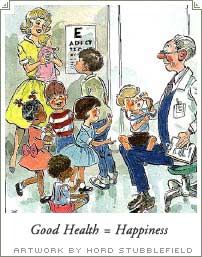
Disclaimer: This post is long. If you don't have time to read it all, the general message is this: Not having health care is a major problem for many people of different income levels. Please consider donating to clinics that serve uninsured individuals, and support policies that will improve access to affordable health care.
As you may have guessed, I support universal health care for multiple reasons. I think it's a fundamental right that Americans deserve. I think it's the job of our government to care for those most in need. But the biggest reason I support universal health care? Because without it, I can't even get a basic doctor's appointment.
Now theoretically, getting a doctor's appointment should be easy for me. I come from a middle-class family and have a college degree. I speak English as a first language, and I'm not afraid to speak assertively to persons of authority. All these things are to my advantage, and yet scheduling a doctor's appointment has always been my idea of a living hell.
Know why? Because I don't have health insurance.
I have held wonderful teaching jobs for the past three years, but only one was full-time, and I haven't had health benefits for a year or more. Unfortunately, health insurance is not offered by all employers. People who work part-time or for a non-profit or are self-employed are usually uninsured, unless they want to pay through the teeth for private individual insurance. States offer insurance for low-income individuals, but these are not often affordable. In New York, I would have paid $350/month for basic health insurance, while working two part-time jobs.
Therefore, I am stuck with no health insurance. And that means I will probably never see a doctor unless I absolutely have to. Unfortunately, at this point in my life, preventative care is just not worth it to me, considering the hassle, humiliation, and financial challenges I have to face to see a doctor.
Here's a recent example. My newest employer, a nature center run by the city, asked me to get a health physical before beginning the job. A simple request, for most people who are insured. But for those who aren't, it's much more complicated...
Step #1: Find a health clinic who will take me.
While the wonders of the internet should make this simple, I have a few limitations. I can't go to a regular private clinic, because the costs for uninsured patients are outrageous. Even if I did want to shell out the money, I don't have an assigned doctor there, so I would have to wait a month to have a "New Patient Appointment," then wait another few weeks to see a doctor. This would mean I couldn't start my new job for at least two months.
I also can't go to some of the free clinics, because they don't offer routine preventative care like health physicals. They're also only open limited hours, mostly during the weekday, leaving me no options if I am already working full-time. (I'm not, but others often face this problem.)
Step #2: Make the appointment.
This involves waiting on hold for at least twenty minutes, if not longer, since low-income health care clinics are often understaffed. I finally got through to the county health clinic, and they told me the earliest I could see a doctor was in November, and that was for a New Patient Appointment. (See Step #1.) Wonderful.
Crossing that clinic off the list, I moved on to the Cristo Rey clinic, whose website said they serve uninsured community members at the low cost of $20 per visit. Perfect. Keep in mind that this nature center job that requires the physical, while a wonderful opportunity, is only paying me $9/hr, so I can't afford an expensive doctor visit.
I decided to call this place. After my second attempt at connecting with someone, the receptionist was very confused and rude when learning that I needed a physical for employment. "Don't you have a family doctor?" she snapped. No, I replied patiently, as I already told you, I don't have health insurance, and haven't had a "family doctor" since I was 17. After we got through these introductions, the clinic then informed me that they don't do physicals for new patients, and if they did, it would cost $80. I would have to work more than a full day to pay that off.
So far I have spent at least 45 minutes on the phone in this process, and still no successful appointment. I also tried Planned Parenthood, whose website said they do employment physicals, but apparently this was erroneous. The receptionist there was shocked when I asked to schedule a physical, and derisively told me "we don't do that here."
Now, this particular story actually has a happy ending. Someone suggested that I look for an urgent care facility, and I was lucky enough to find one which actually took walk-ins and only charged me $39. Awesome for me, but not typical. In my experience in both Chicago and New York, the costs were much higher. I have paid $350 out of pocket for a gynecological appointment, and have heard stories that are much worse. But at least I found a place, so that meant I could move on to the next step.
Step #3: Get to the clinic.
For most people this requires taking time off work, which often equates with a smaller paycheck. I also needed to consider what neighborhood the clinic was in. When I lived in Chicago, there were several neighborhoods where I didn't feel comfortable walking alone. And taking a buddy along was not really an option. Who's going to come to a doctor's appointment with me in the middle of the workday?
I'm also lucky enough to have a car, but many people need to navigate bus routes, resulting in even more time off work.
Step #4: Actually get seen by a doctor.
Now, this is my least favorite step. I have gone to my share of county clinics, and some are better than others. But most are loud, busy, smelly, and stressful. The receptionists are shouting, babies are crying, moms are yelling. The wait is usually at least an hour, if not more (which is annoying at best and takes away from precious work time at worst). The medical staff are trying their hardest, but they're underpaid and understaffed, and stressed. As a result, "welcoming" is not a word I would often use to describe these clinics.
The rest of the appointment is probably pretty typical whether you have insurance or not: the nurse gets me and takes my vitals, then I wait another twenty minutes to see the doctor, then the doctor breezes in and out since I'm her nineteenth patient that day.
But finally, after giving up time, money, patience, and dignity, I have seen a doctor.Now, this small experience, which I have repeated every time I need to see a doctor, is the reason why I support universal health care. It's the reason why the employer-based health care system is not working. The system is not providing people with health care that will prevent them from getting sick.
But until this system gets fixed, please consider donating to a low-income health care clinic in your area. There are people who are facing much larger health issues than I am, and they have a right to see a doctor.
Image source: Carolina Living Health Care
Sunday, August 21, 2011
Fresh from the farm at school

Fresh from the Farm teachers go into classrooms and summer school programs to teach kids about healthy eating, gardening, and cooking. They also work with schools to bring local, healthy foods into school lunch programs. And they recently sponsored another awesome idea, called Truck Farm, which is Chicago's first farm-on-wheels. They're part of the burgeoning farm-to-school movement, which helps schools connect with farmers to bring in fresh, local foods. For more information on the farm-to-school movement, click here...and here...and here.
I love this organization, and the year I spent with them was incredibly educational and exciting. I became a big advocate for local and healthy foods education, and continued to teach it when I moved to New York. Thus, I thought I should dedicate a post to Fresh from the Farm, and highlight their awesome new online resource center. The site has tons of links to curriculum, recipes, articles on obesity and nutrition, and resources for building school gardens. And if you know any teachers who live in the Chicago area, send them to the Fresh from the Farm teacher training, so they can learn to teach the program in their own classrooms!
For more detailed information on what the Fresh from the Farm program is all about, read this article in Chicago's Mindful Metropolis magazine.
Saturday, August 20, 2011
Recipe of the week: Cherry Tomato Orzo Salad
One of my favorite things about summer is making easy, fresh pasta salads. This week's recipe is another delicious one I found on Simply Recipes. The ingredients are easy to find, and prep only takes about twenty minutes. I always double recipes like these so we can eat them for lunch all week long. Enjoy!
 Cherry Tomato Orzo Salad
Ingredients

Ingredients
- 8 ounces orzo pasta
- pinch of salt
- 2 pints tomatoes, chopped
- note: you can chop up any type of tomatoes, but cherry tomatoes are sweet and easy to slice in half so I like to use those
- 1/4 cup olive oil
- 8 ounces feta cheese, crumbled
- 1 large cucumber, chopped
- 2-6 green onions, sliced
- 2 Tbsp fresh oregano, minced
- juice of a lemon
- black pepper to taste
Directions
- Bring a large pot of salted water to boil. Add the orzo and stir so it doesn't stick to the bottom of the pot. Boil uncovered until pasta is firm but cooked all the way through. Strain using a fine mesh sieve so the pasta doesn't go through the holes.
- Toss the pasta with the olive oil. Add the rest of the ingredients and stir.
- If desired, add a little balsamic vinegar and cayenne pepper to give it more flavor. For more protein, add chickpeas or another bean.
- Eat hot or refrigerate for later!
Image credit: Very Culinary
Wednesday, August 17, 2011
Live an invigorating life
I came across some memorable advice from one of the websites I read (Zen to Fitness, an online magazine on health and fitness). The author of the article recommends four simple steps to take towards health. You can read the other three steps on your own. (The article is actually posted on a different and equally awesome blog.) But the section that resonated most with me was Step # 4: Live an invigorating life. While what the author recommends is obviously easier said than done, I think it's a great way of life to visualize and work towards:
Live an Invigorating Life. Last but not least – living an invigorating life is probably the most essential thing when it comes to health and fitness. This means living a life that we get strength or energy from – something that gives us a reason to be active and move.
Whether this energy comes from doing a job you love, being around people you have fun with, travelling or just doing stuff you love. We need something in our lives to gain strength from. Excitement and passion change things up and gives us the motivation to exercise, eat well and most importantly makes us feel good.
I would even go as far as saying one of the best ways to stay fit is just to live life – be active, play with your kids, play tennis, touch football or whatever sports you enjoy, do some bodyweight exercises in the morning, walk lots and eat lots of wholesome food. In all honesty that is how most of the healthiest people I know live.
Saturday, August 13, 2011
Health claims on unhealthy foods need to go

I've found that when I bring up this issue with others, I often get the "why should the government be involved" response. After all, they explain, childhood obesity is largely due to parents' irresponsibility. It's the parents' job to choose which foods children buy and eat. If a child has an unhealthy diet, it's the parents' fault.
I have a pretty big problem with this response (as you might have guessed). Parents are faced with dozens of decisions to make for their kids each day. Ideally, choosing healthy foods for their children should be one of the easier decisions. But instead, parents are swimming in a sea of confusing food products when they enter the grocery store, and many unhealthy foods make health claims that are pretty convincing. And now, a new study shows that these health claims (like "Cocoa Krispies supports your child's immunity") indeed do mislead parents and increase the likelihood that they'll buy these unhealthy foods for their children.
See, in my opinion, almost all parents are trying to do the best they can, and that certainly includes feeding healthy food to their children. But there is a whole mess of things that make this harder for them -- ridiculous health claims on foods that are really not good for you, lack of education and knowledge about how to purchase and prepare healthy food, terrible lunches served at school, and, in some areas, a complete lack of affordable and fresh food nearby. So, for all these reasons, parents are not the only ones at fault when it comes to childhood obesity and malnutrition. And I believe food companies need to be held responsible.
Subscribe to:
Posts (Atom)
